
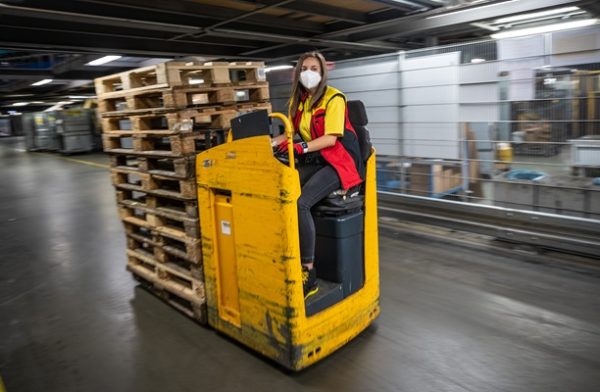
Industrial space is the backbone of many UK businesses. Usually, it’s where all the manufacturing, logistics, warehousing, and processing take place to ensure products are created and/or shipped out on time. They are not client-facing but instead provide a space where all the behind-the-scenes activities that support business operations and efficiency are carried out.
Naturally, then, they are always somewhat in demand. The question is: what is Britain’s industrial property demand right now? Has it changed at all? The answer is an undeniable yes.
Below is a closer look at what’s going on with Britain’s industrial property demand, including recent changes, regional differences, and ways these spaces are adapting to keep up with modern tech.
A quick look at recent changes in industrial property demand
When you look at industrial property in the UK, it is hard to ignore the changes that occurred because of the pandemic.
Pre-COVID: Before the pandemic, there was steadier, more predictable growth in the industrial industry. At this stage, people shopped both in person and online, and warehouses were built for that.
Post-COVID: After COVID, there was a major spike in online shopping, with a lot of panic buying going on. As such, many businesses rushed to buy up more warehouse space to accommodate. Moving past the pandemic, that rush settled somewhat, but a lot of modern technology, such as automation and AI, started being implemented in warehouses more and more. Businesses are now more likely to buy efficient, modern space rather than just a large amount of square footage.
Regional differences in Britain’s industrial property demand
While there are overarching changes to Britain’s industrial property industry, it’s also worth pointing out what the industrial landscape is like in specific UK areas.
- London and South East: In London and the surrounding areas specifically, large warehouses are incredibly scarce, and if you do find one, the rental prices would be extremely high compared to the rest of the country. As such, most industrial space in London often involves smaller units that accommodate quick turnaround in the capital.
- Northern Cities: This includes Manchester, Leeds, Sheffield, and Liverpool. There’s been a major boom here in recent years, with industrial space being much cheaper than in the south.
- The Midlands: The Midlands (also known as the golden triangle) is the warehousing sub-hub of Britain, as it’s bang in the middle of England. So, it doesn’t take too long to reach the south or north, especially when warehouses are on specific motorways like the M1.
- Scotland: There’s a distinct central belt for industrial space in Scotland, which lies between Glasgow and Edinburgh.
- Wales: In Wales, industrial demand is focused on the M4 in the south of the country.
- Northern Ireland: Following Brexit, Northern Ireland has become a sought-after industrial hub for businesses moving goods between the UK and the EU. As such, there’s a definite hub around Belfast, which also covers local logistics demands in Northern Ireland.
So, what about the state of industrial spaces in the UK as a whole?
Shifting towards flexible industrial spaces
In more recent years, there has been a definite turn towards more flexible industrial units. Industrial unit providers like BizSpace, Flexspace, Workspace Group, and The Arch Company are able to offer a wide range of industrial space types, from large warehouses to smaller workshops, with more flexible lease terms. Marketplaces like Zoopla, Loopnet and Rightmove Commercial are a good place to start your search and compare the main providers out there.
The reason companies are more focused on flexible industrial spaces is that they want room to grow. When the business experiences an expansion surge, a flexible space allows it to move along quickly so it can attain the space needed to accommodate the growth.
It’s no longer about rigid, long-term spaces. Instead, it’s about modular warehouses that can mould to all kinds of businesses, large and small. It creates a more fluid, flexible system.
A need for Grade A industrial property
Grade A industrial properties are essentially the most prestigious facilities for logistics and manufacturing around. They are the best of the best. They include state-of-the-art construction, tech, locations, and sustainability abilities. They also tend to be much newer compared to other older warehouses and industrial buildings, often having been built within the last 10 to 15 years.
Another key attribute of Grade A industrial properties is that they are ready for businesses to move in and start processes straight away. Businesses want the space to be fully operational from day one, with everything they need there to accommodate, from high ceilings to heavy-load flooring.
It’s worth mentioning, though, that there is a distinct lack of Grade A industrial properties in Britain right now. The demand is high, but there aren’t actually enough (as of yet) to go around. At the same time, a lot of older, large-space warehouses are sitting empty.
Warehouses that handle AI and automation
You cannot talk about industrial spaces without mentioning the tech overhaul that’s been happening in recent years and how it has affected these properties. AI and automation are all the rage, which makes sense when you look at how much more efficient they can make a business (plus, with the right high-tech, businesses don’t need to hire as many hands).
As such, modern logistics is all about high-tech. In more recent years, especially, warehouses and other types of industrial spaces need to accommodate heavy robotics and AI routing systems. In turn, this has shifted what companies actually look for in an industrial space, as it’s just as much about the power grid capacity as it is about the square footage! After all, these modern tech systems require a lot more electricity.
This trend will likely only continue as technology advances further. Companies want to know that any industrial space they rent for logistics can accommodate the tech they choose to use.
Moving production closer to home
There have been several global shipping delays in recent years for a variety of reasons, including geopolitical tensions. As such, more and more companies are prioritising nearshoring strategies, which essentially means moving their manufacturing closer to home.
This means that there’s more demand for land in the UK. However, the strict planning laws and protected areas in the UK mean that there isn’t always enough land for warehousing to go around, so competition is fierce.
Extremely high costs
Unfortunately, more and more businesses are feeling the burn of sky-high industrial property costs. With all the business costs there are, this is becoming a major issue.
It’s not just the rental prices (although they are high), but it’s also about the:
- Staff wages
- Energy bills
- Cost of materials
All of this has significantly risen in price, especially since the pandemic. As such, many businesses are turning towards smaller, flexible spaces that meet their budget.
Only building warehouses when a tenant is lined up
It’s far more common for developers to only build a warehouse if there is already a tenant lined up, which is known as built to suit projects. Previously, it was reasonable to assume developers would build warehouses without anything lined up, because they would expect that there would be a market for them. However, more and more companies want their industrial space to align with their exact needs, especially if they are going to sign a long-term lease agreement. So, developers will wait so that they avoid having an empty space with no business wanting to move in and pay the rent.
Smaller spaces
There has been a significant micro hub boom in recent years. Previously, super-large warehouses were all the rage to accommodate high-level logistics. However, more businesses are interested in smaller industrial spaces for rapid delivery and flexibility. Plus, they are useful for smaller companies that are on the rise.
Eco-friendly warehouses
The rules around sustainability in UK warehouses are becoming increasingly strict. Just some examples include:
- The Streamlined Energy and Carbon Reporting framework requires businesses to disclose their emissions and energy use.
- The Digital Markets, Competition and Consumers Act 2024, which meant that companies could be fined 10% of their turnover for making false claims about their sustainability.
- The upcoming Extended Producer Responsibility for Packaging, which places the financial burden of household packaging on manufacturers.
Those are only touching the surface. More and more, the UK is becoming more eco-conscious, and that means a lot of new regulations for warehouses to meet. Due to all of this, green features in industrial spaces are anything but optional, but entirely necessary. So, eco-friendly warehouses are highly sought after. Specifically, any industrial property that has electric vehicle charging points, premium insulation, solar panels, energy-efficient LED lighting, and waste automation.
Britain’s industrial property demand: Always changing
It is clear that the demand for industrial property is still as high as ever. However, what businesses are actually seeking out has changed quite significantly, especially since the pandemic and the rise of AI. Some of the most sought-after features of modern industrial spaces are those that are:
- Environmentally friendly
- Flexible
- Closer to UK soil
- In Grade A buildings
- Able to accommodate AI and automation
Who knows what demand will look like in 5, 10, or 20 years? What’s obvious right now is that greener, more efficient industrial spaces are required for businesses to manage operations effectively.


Leave a Comment